The arrival of generative AI has made it easier than ever to produce information. Articles, presentations, campaign ideas, research summaries and entire workflows can now be created in minutes. For Silvia Mogas, that abundance is changing the competitive landscape in a more fundamental way than the technology itself.
The entrepreneur and strategist from Barcelona has spent much of her career helping companies turn complex ideas into propositions that markets can understand, trust and adopt. Her work today spans AI, digital assets, tokenisation, market strategy and distribution, but a growing part of her thinking centres on a different question: when almost anyone can create more content, more analysis and more visibility, what makes one person, company or source worth trusting?
Mogas believes the answer increasingly lies in authority rather than volume. The shift matters for companies, executives and institutions because AI is beginning to shape not only how information is produced, but also how it is discovered, compared and acted upon.
“AI has made creation abundant,” she says. “The scarce part is becoming judgement: knowing what is credible, what is useful and what deserves to influence a decision.”
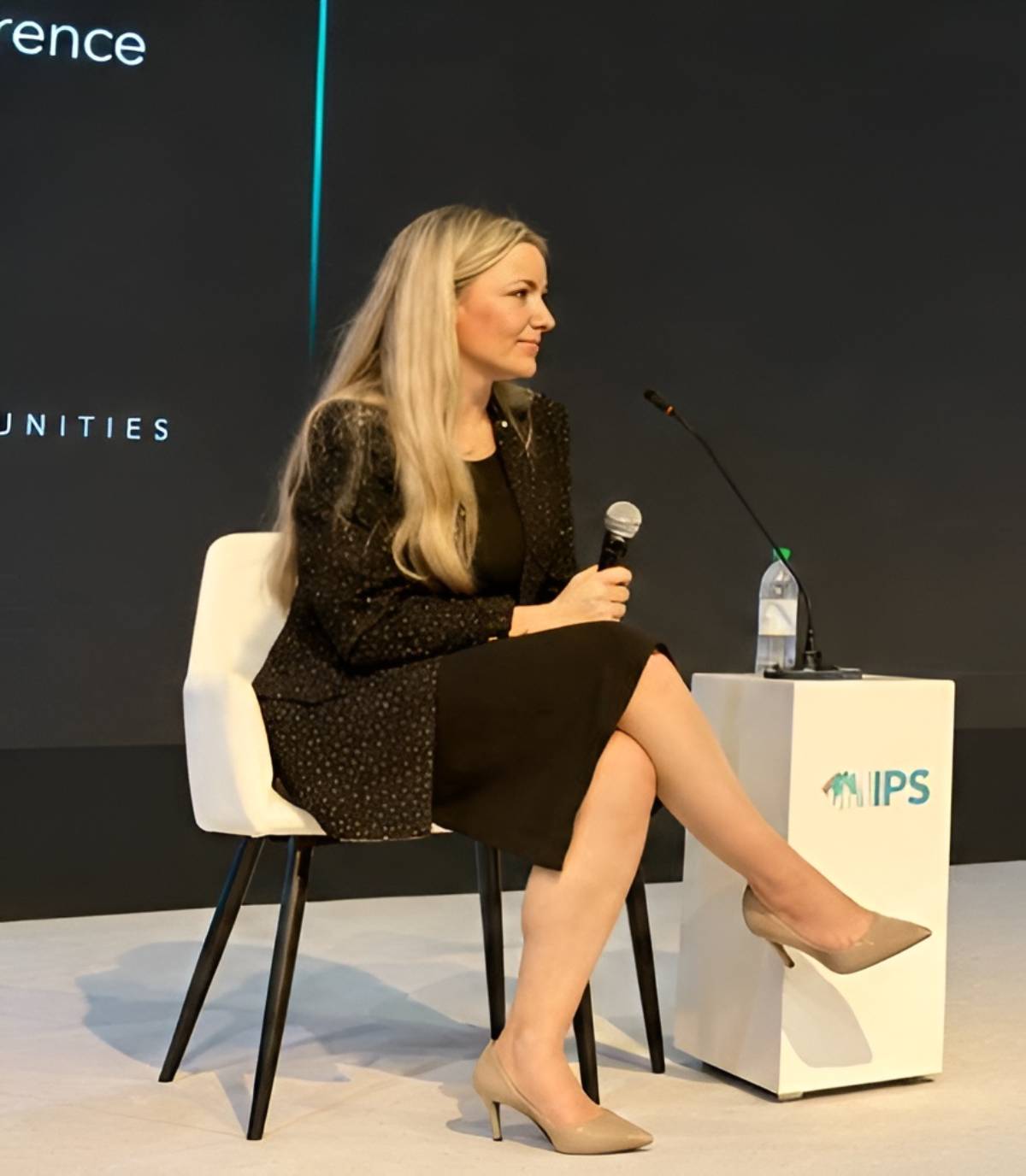
Instagram @silviamogas.onchain
That idea is informing the next phase of her work. Through Blockchain Marketing Boutique, the strategy firm she founded, Mogas and her team help companies in emerging technology and market transformation clarify where they create value, position themselves credibly and reach the right market. They combine strategy, senior relationships, partnerships and distribution to support real adoption. In parallel, she is building Trust the Signal, a media platform focused on emerging technology, markets, trust, and real-world adoption.
Both initiatives sit around the same underlying issue: credibility is becoming an operating asset.
FROM ATTENTION TO AUTHORITY
For years, digital strategy rewarded visibility. Companies invested heavily in reach, search rankings, content volume, communities and social media presence. Those channels remain important, but the economics of content are changing quickly.
When AI can generate almost infinite variations of the same information, producing more no longer guarantees differentiation. Mogas sees this as the beginning of a transition from the Creator Economy towards what she calls an Authority Economy.
In that environment, the question moves from “who can publish?” to “who is worth listening to?”
Authority, in her view, is built through evidence, consistency, domain expertise, provenance and a record of making useful decisions. It is harder to manufacture because it compounds over time. A strong reputation may begin with visibility, but it is reinforced by the quality of the work behind it and by whether other credible people, institutions and systems continue to recognise it.
That distinction has practical consequences for businesses.
A company entering a new market may have excellent technology and still struggle if buyers do not understand its relevance. A founder may have a large audience without being trusted by institutional decision-makers. A financial product may be technically sound but fail to reach the right investors or distribution channels. In each case, visibility alone does not solve the commercial problem.
Mogas has seen this repeatedly in digital assets and tokenisation, where market adoption depends on far more than infrastructure. Product positioning, institutional relationships, education, market access and distribution all shape whether an innovation reaches real users.
The same logic now applies to AI.
As companies race to adopt new tools, the differentiator is becoming the ability to identify where AI genuinely improves a workflow, a decision or a customer experience, and then implement it with the governance required for people to rely on the result.
“Trust is built when what you say, what you build and what people experience remain aligned,” Mogas says. “In complex markets, credibility becomes part of the product.”
THE NEXT SHIFT: WHEN AGENTS START CHOOSING
Mogas believes the Authority Economy is likely to be followed by another change: the Agent Economy.
AI systems are moving beyond content generation and simple assistance. Increasingly, software agents can search, compare, organise information, initiate workflows and make recommendations on behalf of users. As those systems become more capable, they will also influence which companies, experts, products and sources are surfaced.
This creates a new distribution challenge.
For years, organisations learned to optimise for search engines and social platforms. The next stage may require them to think about how AI systems interpret their expertise, evidence and reputation.
Mogas describes this as the movement from SEO to answer-engine optimisation and eventually to agent selection: the point at which machines are not only retrieving information but helping decide which sources or providers deserve attention.
That does not make human reputation less important. It raises the standard.
Companies will need clearer evidence behind their claims, more structured and consistent information, stronger provenance and a credible public record. Executives will also need to think about how their expertise is represented across digital environments that machines can interpret.
This is one reason Mogas has become increasingly interested in what she calls machine-readable authority: the idea that credibility needs to be visible not only to people, but also legible to the systems that increasingly mediate discovery.
The subject may sound technical, but the business implication is straightforward. When an AI system helps a customer choose a provider, an investor research a market or an executive compare strategic options, the sources it trusts can influence real economic decisions.
For Mogas, this makes Trust a distribution issue as much as a reputational one.
LEADERSHIP IN A MORE AUTOMATED ECONOMY
The rise of AI agents also changes what leadership requires.
Mogas works with companies where AI is being considered for customer processes, operational workflows, decision support and other areas where automation can create meaningful gains. In those environments, implementation quickly raises questions that extend beyond technology.
Who owns the decision? Where does human oversight remain necessary? What happens when an automated system acts incorrectly? How is the output explained? Which data is being used? How much autonomy should an agent have?
These are business and leadership questions as much as technical ones.
For Mogas, Trust and Ethics need to be built into implementation from the beginning, particularly in financial services, real estate, capital markets and other high-stakes environments.
She argues that leaders will increasingly need to understand enough about AI to make informed decisions without pretending to be engineers. Their role is to connect technology with business value, governance, customer impact and accountability.
That requires judgement across disciplines.
The strongest leaders, in her view, will be those who can move comfortably between strategy and implementation: understanding where a technology creates value, asking the right questions of technical teams, recognising operational risk and ensuring that someone remains accountable for the outcome.
This approach reflects the way Mogas has built her own career. Her background spans marketing, product, entrepreneurship, digital assets and emerging technology, and she has repeatedly moved into unfamiliar categories by learning through direct involvement rather than observing them from a distance.
She continues to participate in hackathons for the same reason. They force ideas to be tested under pressure and require collaboration across product, technology and business. Her recognised work includes projects across Polkadot, Coinbase Developer Platform, Permissionless and ETHGlobal, with projects in 2026 receiving recognition in Cannes, New York and Lisbon.
For Mogas, those environments are useful because they expose the distance between an interesting concept and something that actually works.
REAL-WORLD ADOPTION AS THE TEST
This emphasis on execution runs through her work in both AI and digital assets.
Mogas has spent several years working across Web3, Bitcoin, tokenisation, real-world assets and financial infrastructure. One of the lessons she takes from that period is that technical possibility can arrive long before market adoption.
A tokenised asset may function exactly as designed and still fail to gain traction. An AI system may perform impressively in a demo and still fail inside an organisation. In both cases, the missing elements are often commercial and operational: distribution, workflow design, decision ownership, market education, relationships and Trust.
This is why Mogas returns repeatedly to real-world adoption as the more useful measure of progress.
The question is not whether a technology is sophisticated. It is whether it changes something that matters.
Does it reduce friction? Improve access? Help an institution make a better decision? Reach a market that was previously difficult to serve? Create a more efficient workflow? Build confidence around a process that users previously avoided?
These questions also shape how Blockchain Marketing Boutique works with clients, with Mogas directly involved in strategy and key relationships.
For Mogas, the role of strategy is to connect the pieces that determine whether innovation can move: the product, the market, the buyer, the operating context and the channels that create access.
WOMEN, AUTHORITY AND ACCESS
Femest has long focused on women building influence through entrepreneurship and leadership. For Mogas, the discussion around authority also has a gender dimension.
Women are entering AI, fintech, digital assets and emerging technology at a moment when many of the sector’s professional hierarchies are still being formed. That creates an opportunity, but access remains uneven.
Mogas is a SheFi Chapter Lead for Spain and El Salvador and has mentored founders, students and women entering technology. She sees support as most valuable when it becomes practical: an introduction, a recommendation, a speaking opportunity, a useful piece of feedback or access to a room where decisions are being made.
“Someone opening a door can change the direction of a career,” she says. “Once you have access, part of the responsibility is making sure that door stays open for somebody else.”
Her own work in education follows the same principle. Mogas lectures at EAE Business School and has been a guest lecturer on the MBA Innovation & Change Management programme at EM Normandie Business School in Dubai. She has also contributed to research on AI and blockchain, served as an advisor and judge, and spoken at major international conferences.
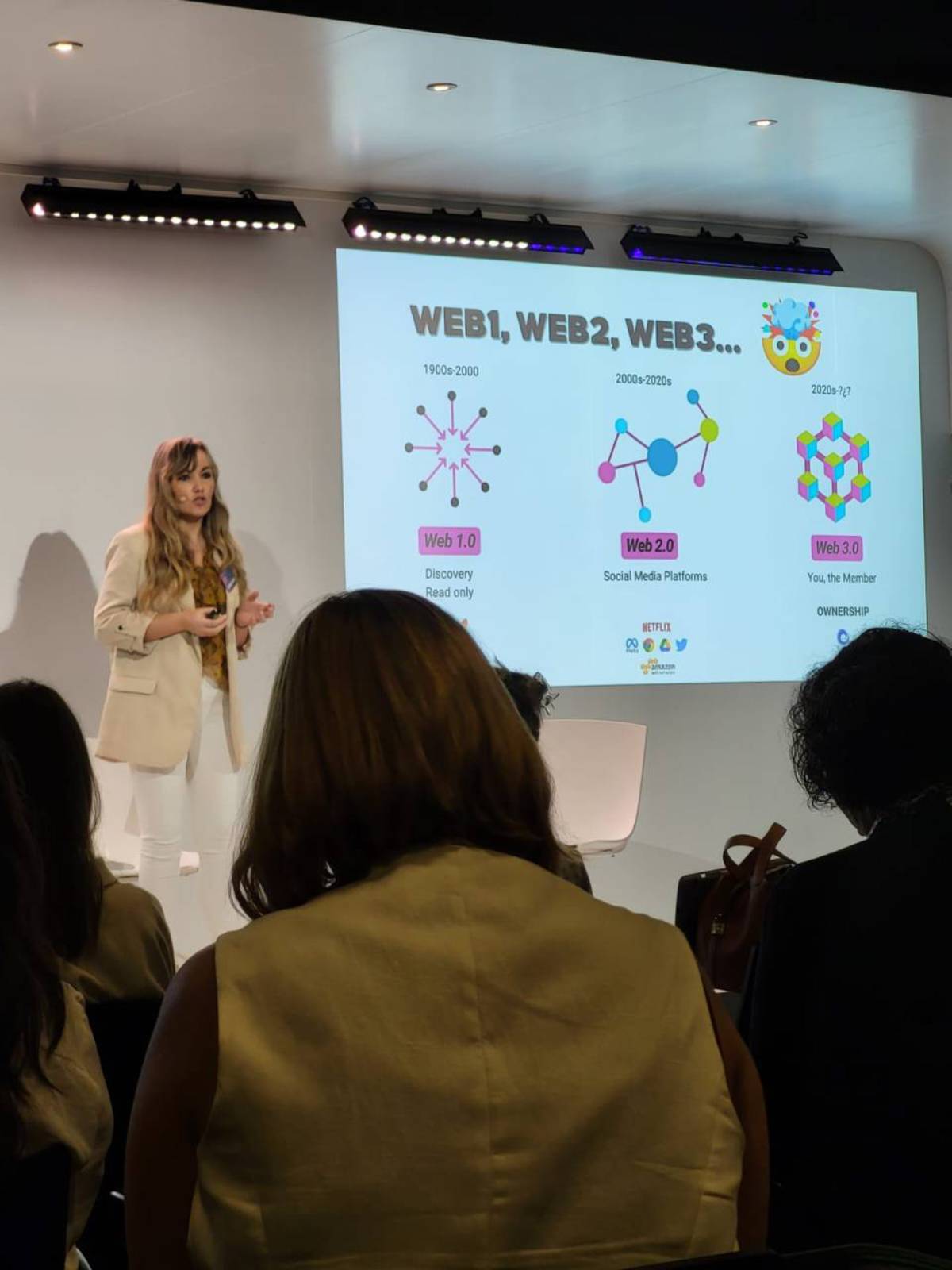
Her speaking engagements include Mobile World Congress, South Summit Madrid, AIM Congress in Abu Dhabi and Taipei Blockchain Week. At the Science Summit during the 81st United Nations General Assembly, she presented “Emerging Tech to Real Adoption: AI, Blockchain & On-Chain Infrastructure”, extending the same argument she brings to her commercial work: innovation matters when institutions and markets can actually use it.
She is also occasionally invited to Radio Intereconomía in Spain to discuss digital assets, tokenisation and developments shaping the sector.

BUILDING A PUBLIC RECORD THAT COMPOUNDS
Mogas’s broader professional recognition includes Marketing Leader of the Year 2024 in Dubai, Global Top 100 Women of the Future in Emerging Tech and LinkedIn recognition for Marketing Strategy and Web3. She has also been recognised through hackathons, research, teaching and international speaking.
She does not treat those signals as a collection of badges. In the context of the Authority Economy, they illustrate a wider point: professional reputation is built through repeated evidence.
A strong public profile becomes more valuable when it connects to a body of work that can be examined. Speaking, writing, teaching, building, client work and independent recognition reinforce one another when they point to the same areas of expertise.
That principle is also behind Trust the Signal.
The media platform gives Mogas a place to develop ideas around AI, digital assets, markets, Trust and adoption in a format that is more durable than social media. Rather than competing for daily volume, the aim is to build a body of analysis that remains useful and can be referenced over time.
For Mogas, this is an important distinction as AI changes how information circulates.
“If everything becomes easier to produce, the value moves towards what can be verified, trusted and used,” she says.
WHAT COMES NEXT
Mogas’s current work increasingly sits where several markets are converging: AI and agentic systems, digital assets and tokenisation, institutional adoption, distribution and Trust.
She sees those areas becoming more connected rather than developing independently.
AI agents may eventually interact with financial products, payments and digital infrastructure on behalf of users. Tokenised assets will require clearer distribution and stronger integration with existing financial markets. Companies will need to establish authority with both human decision-makers and the systems that increasingly shape discovery.
For leaders, the challenge will be deciding which changes deserve attention and which are simply noise.
Mogas does not believe the answer is to chase every new technology. Her approach is to understand where a shift creates real business value, stay close enough to the market to see how adoption is evolving and build the credibility required to act when the opportunity is real.
That may be the defining leadership advantage of the next technology cycle: the ability to combine curiosity with judgement, speed with accountability and innovation with Trust.
For Mogas, the goal is ultimately practical.
“The technology will keep changing,” she says. “What matters is whether you can understand what is meaningful, build the right relationships around it and turn it into something people and organisations can actually use.”